Recommendations for Infrastructure Design
The example configurations here combine the elements of the examples from Recommendations for Network and Hardware Design as well as the different infrastructure solutions from Considerations for Infrastructure Design. These focus on the internal configuration of the master node but these examples can be extrapolated for configuring login, storage, compute or any other nodes that are part of the HPC environment.
Simple Infrastructure
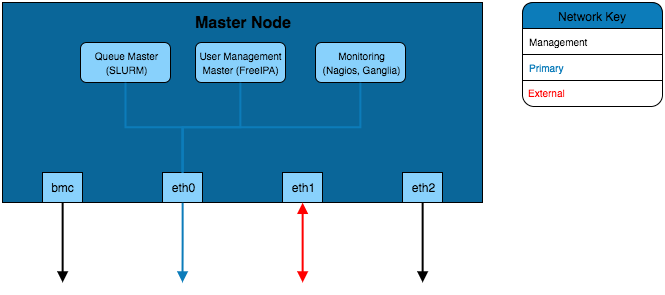
The simplest infrastructure configuration uses the all-in-one approach where services are configured on the master node’s operating system.
Virtual Machine Infrastructure
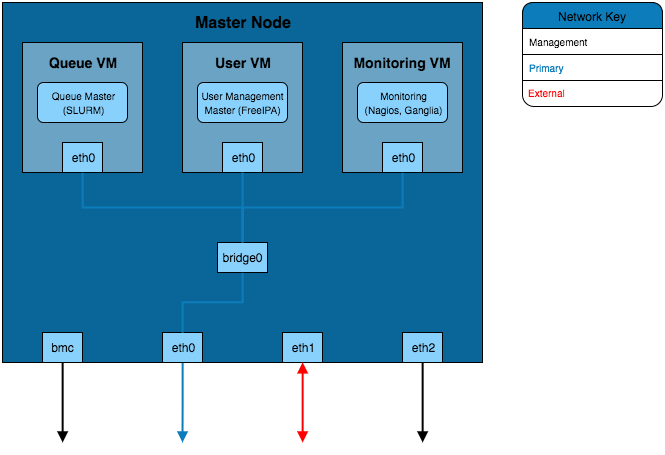
This solution separates the services into VMs sat on the master node. In order for these VMs to be able to connect to the primary network a network bridge is created that allows the VM interfaces to send traffic over the eth0 interface.
Channel Bonded Infrastructure
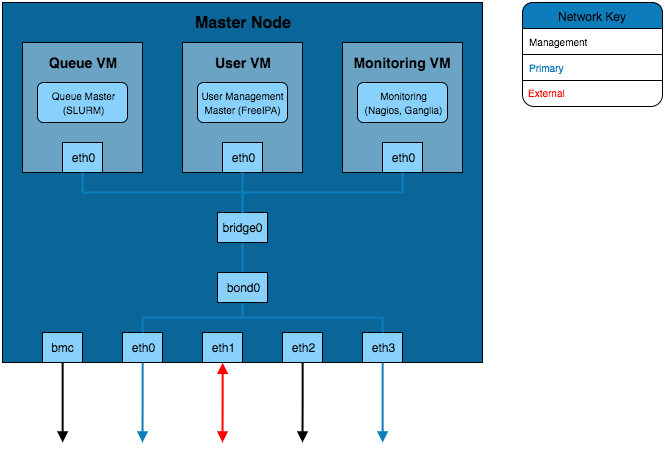
This example adds a layer of redundancy over the VM Infrastructure design by bonding the eth0 and eth3 interfaces. These interfaces are connected to separate network switches (the switches will be bridged together as well) which provides redundancy should a switch or network interface fail. Bonding of the two interfaces creates a new bond interface that the bridge for the virtual machines connects to.
VLAN Infrastructure
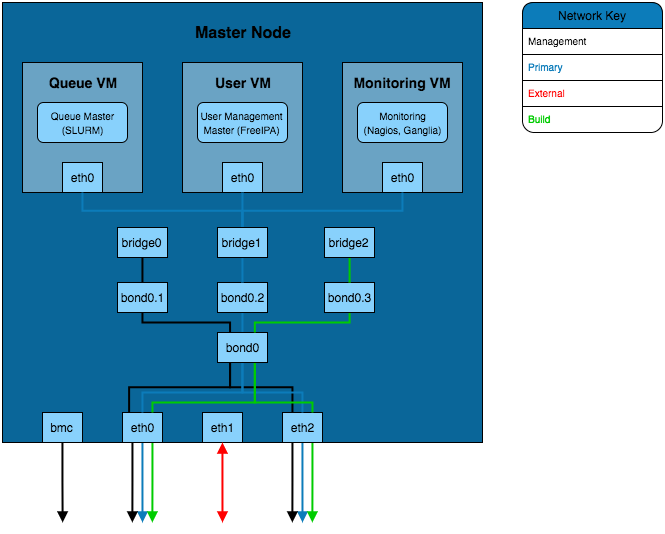
The above solution implements the channel bonded infrastructure in a network with VLANs. The VLANs have bond and bridge interfaces created for them. This allows some additional flexibility for VM bridging as virtual interfaces can be bridged onto specific VLANs whilst maintaining the redundancy provided by the bond. This adds additional security to the network as the master node can be left without an IP on certain VLAN bond interfaces which prevents that network from accessing the master node whilst VMs on the master node are able to reach that VLAN.